You are a wise member of the proud and noble Clan Auran. You bear no love for your ancient enemies in Clan Irgentum, but nonetheless you hope to end the feud, because in your wisdom you know that violence begets only more violence.
But you also know that among your family are rash young idealists who seek to purge your ancient foe forever, and bitter old souls who recall the injuries suffered at that foe’s hands like it was yesterday. They are not among the majority, but some would be hard to dissuade.
The annual Day of Vengeance approaches. Your cousin comes to you on the eve before, and says: “I think Clan Auran will march to war.”
“Some may,” you admit. “But it would be foolish in the extreme to set forth alone.”
“I know this,” says your cousin seriously, “and you know this, but there are those among our family who do not know this. They will march regardless, and if they march alone, they will surely perish. If the clan marches with them, they will survive. Will you condemn the bravest and boldest of our clan to death?”
“They might not march,” you object, “if they see clearly enough that they march alone.”
“They will not see so clearly,” says your cousin sadly. “Some among us will surely die.”
“I am afraid so,” you admit. “But to bring more of the clan to the fight will only cause more needless deaths.”
“Not so,” objects your cousin. “If enough of the clan march to war, our foes will see our numbers and flee, and the restless and bitter among us will be satisfied, and there need be no deaths among our beloved kin.”
“To accomplish this would take more than half our entire clan!” you exclaim. “Surely there is more wisdom among us than that.”
“Ah, but you forget the love we hold for one another,” your cousin observes. “The bonds of family are a powerful thing. Where the youngest may march to war against the warnings of his brethren and elders, still his brethren do not wish to lose him. Some will march to war for his sake, and still others will march for theirs, and so on. We would not need the whole clan to march, only a majority, for all we love to be saved. It may take a heroic effort, but no one needs to die tomorrow.”
You feel yourself becoming frustrated. “And if that same effort were dedicated instead to convincing the restless and the bitter to remain behind, among their loved ones, and not march to their deaths in a pointless feud, no one would need to die tomorrow either!”
“The hour is late,” your cousin reminds you, “and most will have made their decision already. In accordance with our traditions, those who plan to march to war on the morrow must paint their spears blue in honor of the river that divides our lands from those of our hated rival; and those who intend to remain must paint their spears red in honor of the sun that sets behind our sacred hills. Even if you were to violate these traditions, you would not be able to convince more than the barest fraction of our clan to change their minds before the march begins.”
“But that could result in the worst possible outcome!” you lament. “If many of our clan march to war, but their numbers are not enough to frighten off the foe, they will all be killed by our enemies, who have never been known to show mercy! If it is foolish to march alone, it is even more foolish to decide whether to march without knowing how many of our kin will join us!”
“And yet that is the decision we now face,” says your cousin sadly, “and no amount of wishing will change it.”
“Can I at least convince you to remain, and spare your own life in the event of tragedy?” you plead.
“Alas, you cannot,” responds your cousin, “for my sister lost her husband and child in the last raid. She will surely be among those who march to war, and I love her more than life itself. Good night, my cousin, and if we are not blessed to meet again before the Day of Vengeance ends, farewell.”
You watch your cousin leave, straight-backed and proud, and wonder how it got to this point. You return to your home; you descend into the cellar, ancient stairs carved by your great-grandfather creaking under your weight. You clear the dust from an old table, and on it you place three items taken reverently from where they have been stored: a single stout spear, battle-worn but reliable, and two weathered boxes of dry paints, one red, one blue.
Tim Urban of Wait But Why recently revived a scissor statement, an especially divisive question, that did the rounds on the internet a while back:
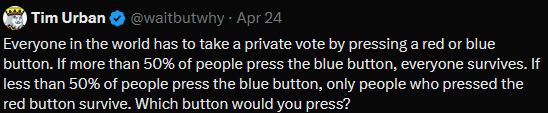
Lots of people got pretty mad about this.
The first step when facing a hard choice is to acknowledge it as such. Likewise, the first step when facing a sincere and meaningful disagreement among friends is to acknowledge it as a sincere and meaningful disagreement.
The second is to seek the core elements that make it hard to resolve.
Contrary to what some on the internet may suggest, I do not think that the fundamental problem here is that blue-button-choosers are stupid naive twits who deserve to die and good riddance. Nor do I think the problem is that red-button-choosers are selfish assholes who would let others burn to save themselves.
In a world of perfect reasoners with mutual knowledge of each other’s goals, everyone coordinates on red or blue by some feat of logic to which there is an objectively correct answer, for the same reason that the movement of perfect spheres in a frictionless vacuum has an objectively correct description. But the real world is considerably messier. The story above is my attempt to take the frictionless-spheres-in-a-vacuum thought experiment and add back a little bit of grounding in situations humans might actually face, and in so doing to illustrate some of what makes the question so divisive.
We could imagine a world of blue-button-pushers, all looking to make the world safe for everyone, with a very comfortable margin to ensure that no one dies. We could imagine a world of red-button-pushers, who correctly expect that pushing blue gets someone killed at no benefit to the group, and so virtually nobody does. We could even imagine a world split almost 50-50, in which a single person’s choice stands a meaningful chance of making the difference between four billion deaths and zero.
The problem is that we don’t know which world we’re in just by looking at the question.
If we take the question seriously, and we choose to care at all about the fate of our fellow humans even for selfish reasons, we have not yet resolved the conundrum. We must still decide based on guesses about other people’s decisions, and guesses about their guesses, and so on. Whatever your intuitions may be, I beg you to acknowledge at least that this is not necessarily an easy decision to make.
Nor should it be, really. The world of blues is a world of trust and charity, filled with people who would gladly accept a small risk to themselves to make sure that no one slips through the cracks. The world of reds is a world of agency and self-sufficiency, filled with people justly confident that their society neither needs nor demands their sacrifice, because everyone can and does look out for themselves.
These visions are beautiful to me, each in their own way. Yet to live in one of them forever, I think, would be to lose something precious. For that reason alone, we ought to extend a modicum of kindness to those whose intuitions clash with our own.
The world in the middle is messy. And like it or not, so is the world in which we currently live.
It’s okay to feel conflicted about that, sometimes.